The Asian Longhorned Tick
Haemaphysalis longicornis
A newcomer from East Asia, first found in New Jersey in 2017 and now established across much of the mid-Atlantic. It is mainly a threat to livestock and pets, though researchers are still studying which human diseases it can carry here.
- Carries Lyme
- No
- First US find
- New Jersey, 2017
- Main threat
- Livestock
- Reproduces
- Without males
- Range
- Mid-Atlantic, spreading
Quick facts
Diseases it can carry
Livestock impact
The biggest known threat here is to animals. Heavy infestations can drain enough blood to weaken or kill cattle, and the tick can transmit Theileria, a parasite that causes disease in cattle.
Human disease (under study)
Abroad this tick transmits several human pathogens, and in the lab US ticks can carry some. Whether it meaningfully spreads disease to people in the US is still being studied, so bites are worth noting.
It is not a known vector of Lyme disease.
How to identify it
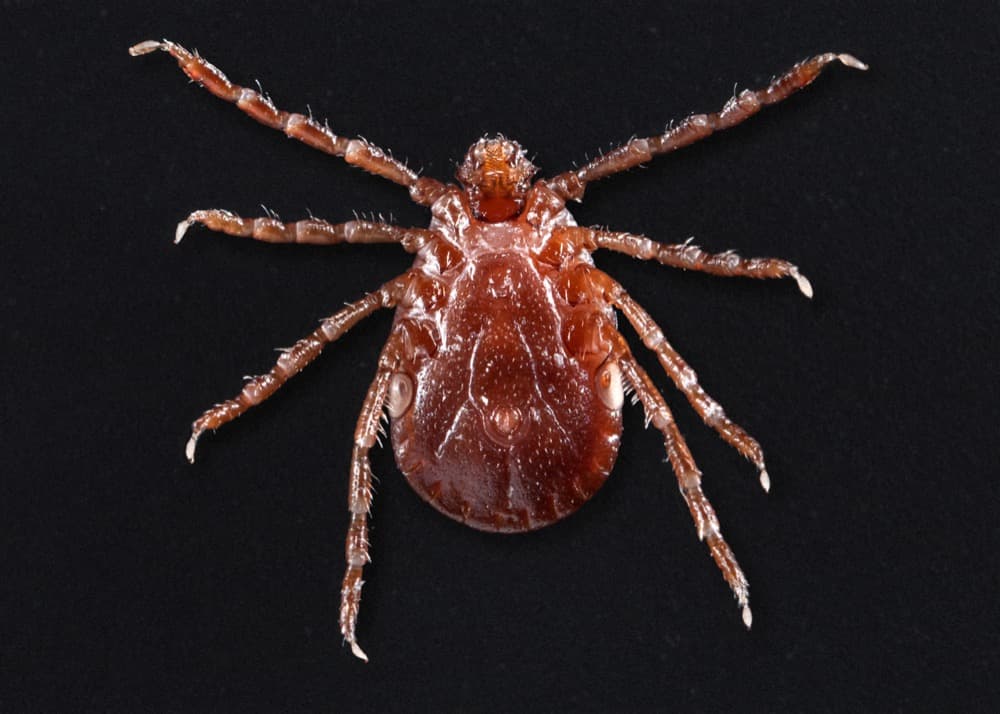
- Small and plain reddish-brown with no markings, easy to mistake for other young ticks.
- The telling sign is numbers: dozens to hundreds on a single animal.
- Nearly every one you find is female; males are almost never seen.
When and where
Active spring through fall in tall grass and pasture edges across the mid-Atlantic and spreading. It hits cattle, horses, dogs, and wildlife hardest, and can cover a host in huge numbers.
Range in the Northeast
First detected in New Jersey in 2017, the Asian longhorned tick is now established across much of the mid-Atlantic and the New York, New Jersey, and Connecticut tri-state area, with populations in Pennsylvania and detections pushing into New England. It is one of the fastest-spreading ticks in the country. If you find a heavy cluster of small identical ticks on a pet or farm animal, save a few and tell your vet or state agriculture office.
Frequently asked questions
- Where is the Asian longhorned tick found?
- First detected in New Jersey in 2017, it is now established across much of the mid-Atlantic, including New York, New Jersey, Connecticut, and Pennsylvania, and it continues to spread north and west. Its range is actively tracked by state agriculture and health agencies.
- Is the Asian longhorned tick in the tri-state area?
- Yes. The New York, New Jersey, and Connecticut tri-state area is one of its established strongholds; New Jersey was where it was first found in the US in 2017. It is well established across much of the region and continues to spread outward from it.
- Is the Asian longhorned tick in Maine or the rest of New England?
- Its established core is the mid-Atlantic and tri-state area, and it is spreading north. Detections have moved into parts of New England, but it is not yet as widespread there as in New Jersey and New York. State agencies are actively monitoring its northward spread.
- Is the Asian longhorned tick dangerous to people?
- Its clearest threat is to livestock and pets, which it can infest in huge numbers. Whether it meaningfully transmits disease to people in the US is still under study, so a bite is worth noting even though the human risk here is not yet well defined.
- Why are there so many of them at once?
- Females can reproduce without mating, laying thousands of eggs on their own. That lets a single tick seed a swarming infestation, which is why you may find dozens to hundreds on one animal.