The Rocky Mountain Wood Tick
Dermacentor andersoni
The Rocky Mountain wood tick is the tick most likely to bite you across the mountain and interior West. It is a spring tick, active from March into early summer in shrub-steppe and along grassland and forest edges, and it carries Rocky Mountain spotted fever, Colorado tick fever, tularemia, and can cause tick paralysis. It does not spread Lyme disease.
- Carries Lyme
- No
- Carries
- RMSF, Colorado tick fever, tularemia
- Peak season
- Spring (Mar to June)
- Elevation
- About 4,000 to 10,500 ft
- Where
- Rocky Mountain and interior West
Quick facts
Diseases it can carry
Rocky Mountain spotted fever
The Rocky Mountain wood tick is a primary vector of RMSF (Rickettsia rickettsii), a serious and potentially fatal bacterial infection. It is treatable with doxycycline, and starting treatment early, before test results, is what saves lives.
Colorado tick fever
A viral infection found only where this tick lives, causing fever, chills, headache, and body aches that often come in two waves. There is no specific treatment beyond supportive care, and most people recover, though fatigue can linger for weeks.
Tularemia
A bacterial infection (Francisella tularensis) that this tick can transmit, with fever and often an ulcer at the bite. It is uncommon but serious, and responds to antibiotics.
Tick paralysis
A prolonged bite from a female can cause a rare, reversible paralysis driven by a toxin in her saliva, most often reported in children. It resolves once the attached tick is found and removed, which is one more reason to do a thorough tick check.
It does not carry Lyme disease, which is uncommon across almost all of the West.
How to identify it
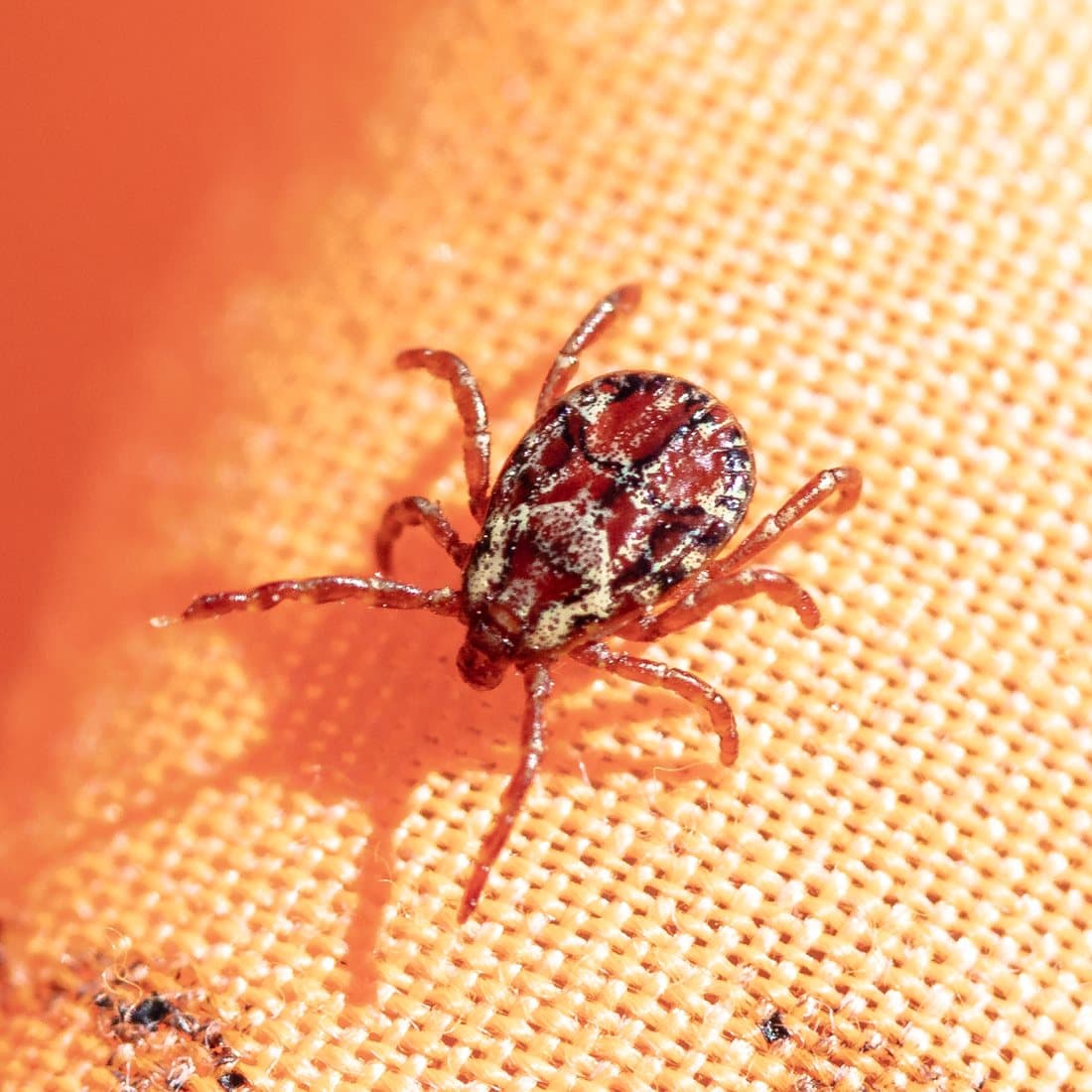
- Brown body with an ornate off-white and gray marbled shield behind the head, very similar to the American dog tick.
- Found in the interior West, not the East, which is the surest clue to species.
- Most people encounter adults in spring, questing from grass, brush, and rocky slopes.
When and where
Adults quest for hosts from March into early summer, peaking in April and May, then largely disappear by mid-summer as the high country dries out. It lives in shrub-steppe, sagebrush, rocky slopes, and the edges between grassland and forest, generally between about 4,000 and 10,500 feet, across the Rocky Mountain states and the interior Northwest.
Range in the Northeast
The Rocky Mountain wood tick ranges across the intermountain West, from southern British Columbia and the Canadian prairies down through Montana, Idaho, Wyoming, Colorado, Utah, Nevada, and the drier interior of Washington, Oregon, and eastern California, reaching its southern limit in northern Arizona and New Mexico. It is a creature of elevation and open, semi-arid country, which is why interior-West risk peaks in spring rather than mid-summer.
Frequently asked questions
- Does the Rocky Mountain wood tick carry Lyme disease?
- No. It does not spread Lyme disease. Its main concerns are Rocky Mountain spotted fever, Colorado tick fever, tularemia, and, rarely, tick paralysis. Lyme is carried by blacklegged ticks, which are uncommon across almost all of the interior West.
- When is the Rocky Mountain wood tick active?
- It is mainly a spring tick. Adults quest from March into early summer, peaking in April and May, and largely disappear by mid-summer as the high country dries. This is the opposite of the Northeast, where tick risk peaks in mid-summer.
- How is it different from the American dog tick?
- They are close relatives and look alike, both brown with an ornate marbled shield. The surest difference is range and habitat: the Rocky Mountain wood tick lives in the interior West at higher elevations, while the American dog tick is common in the East and in open, grassy areas.
- What is Colorado tick fever?
- A viral illness spread by this tick and found only where it lives. It brings fever, chills, headache, and body aches that often return in a second wave. There is no specific antiviral treatment; care is supportive, and most people recover fully.